


A useful guitar range is not simply a long list of models. It gives the purchasing team a reason for every item, helps sales staff explain the differences in a few sentences, and makes it easier for a buyer to choose without comparing several nearly identical guitars. For a distributor or music retailer, that clarity matters more than the number of products shown in a catalogue.
SMIGER, established in 2016, covers acoustic and electric guitar categories with different body formats, materials and feature sets. That breadth gives a buyer room to build an assortment, but it also creates a practical question: which models should sit beside one another, and what job should each model perform?
The answer begins with product roles. One guitar may provide a familiar full-size acoustic option. Another may add a thinner body and onboard controls. An electric model may introduce features that support silent practice and demonstration. These are understandable differences that a retailer can present, verify and repeat. This guide explains how to turn those differences into a clear SMIGER range without relying on vague labels or unsupported promises.
In practical terms, start with the smallest set of models that answers different customer questions. Give each guitar one primary role, compare it through current specifications, and add colours or closely related versions only after the core roles are clear. This prevents the catalogue from growing faster than the staff’s ability to explain it.
Start with the customers your sales team actually serves
Before selecting model numbers, write down the main buying situations that appear in the business. A general music shop may need a familiar acoustic guitar for first comparisons, a second acoustic with a different body feel, and an electric option that creates a clear reason to move into another category. A distributor supplying several store types may need broader coverage, but every model should still answer a specific need.
Useful customer roles might include a learner looking for a straightforward first full-size acoustic, an existing player comparing solid-top instruments, a player who prefers a thinner body, or an electric-guitar customer who values practice functions. These roles are not rigid consumer profiles. They are planning tools that connect a product specification to a real sales conversation.
Avoid beginning with labels such as “entry,” “premium” or “professional” unless the business has defined what those words mean. A specification-led description is more useful: 41-inch acoustic with a solid spruce top; 40-inch thin-body acoustic with onboard volume and tone controls; or electric guitar with HSS pickups and integrated practice functions. The sales team can explain those differences without inventing a quality ranking.
Give every model one primary role
Overlap is normal in a guitar assortment, but unnecessary duplication makes the range harder to manage. Each selected model should have one primary role and, at most, a few supporting reasons for inclusion.
A simple planning table can contain these fields:
| Model | Primary retail role | Main verified comparison point |
|---|---|---|
| SMIGER GN-81D | Full-size acoustic reference | 41-inch format, solid spruce top, sapele back and sides |
| SMIGER LE-A1 | Thin-body acoustic alternative | 40-inch thin body, solid spruce top and onboard controls |
| SMIGER L-G2-i3 | Electric and practice-function extension | HSS Alnico V layout and published onboard functions |
Brand and model
Instrument category
Primary range role
Body size and format
Main construction facts
Pickup or control layout
Finish and current colours
Customer question the model answers
Product-page URL and date checked
Specification points still awaiting confirmation
The final two fields are important. Product pages can change, and older listings sometimes contain incomplete or inconsistent wording. A dated source and a visible “confirmation required” field prevent uncertain information from becoming an established catalogue claim.
Use the GN-81D as a clear full-size acoustic reference
The SMIGER GN-81D has a straightforward published specification: a 41-inch acoustic format, solid spruce top, and sapele back and sides. Those details give it a clear role in a retail assortment. It can serve as the reference model when staff explain what “solid top” means and how the top construction differs from the back-and-side specification.
That role is stronger than a broad description such as “good acoustic guitar.” A salesperson can identify the model, point to its full-size format, state the verified construction, and compare it with another guitar that changes body depth, controls or materials. The same information also gives the purchasing team a practical incoming check: model identity, body format, top description, finish and visible presentation should match the approved reference.
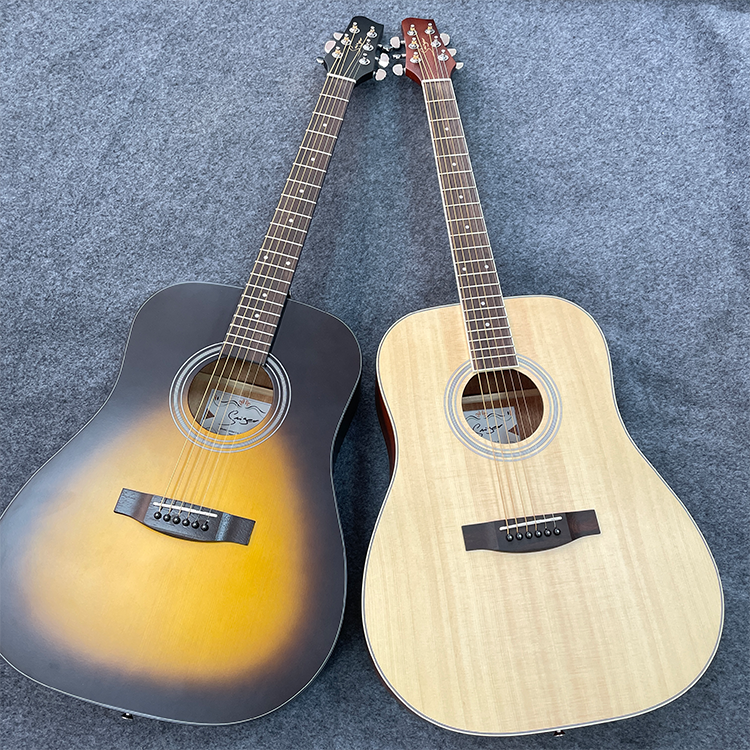
The GN-81D provides a clear full-size acoustic reference with a published solid spruce top and sapele back and sides.
The range does not need several guitars that repeat this same explanation. If another full-size acoustic is added, it should introduce a visible or functional difference that staff can describe accurately.
Add the LE-A1 for a different acoustic conversation
The SMIGER LE-A1 creates a different role. Its published information lists a 40-inch thin-body format, solid spruce top, okoume back and sides, wood binding, technical-wood fingerboard, rosewood bridge, bone nut and saddle, stainless-steel rounded fret ends, chrome hardware, and onboard volume and tone controls. Current colours listed on the page are 3TS and N.
For a retailer, the important point is not that this list is longer. It is that the features change the sales comparison. The thinner body gives staff a physical difference to demonstrate beside the 41-inch GN-81D. The control layout also changes the questions that should be asked during product review. Instead of presenting two nearly identical acoustics, the store can show a conventional full-size solid-top option and a thinner solid-top model with onboard controls.
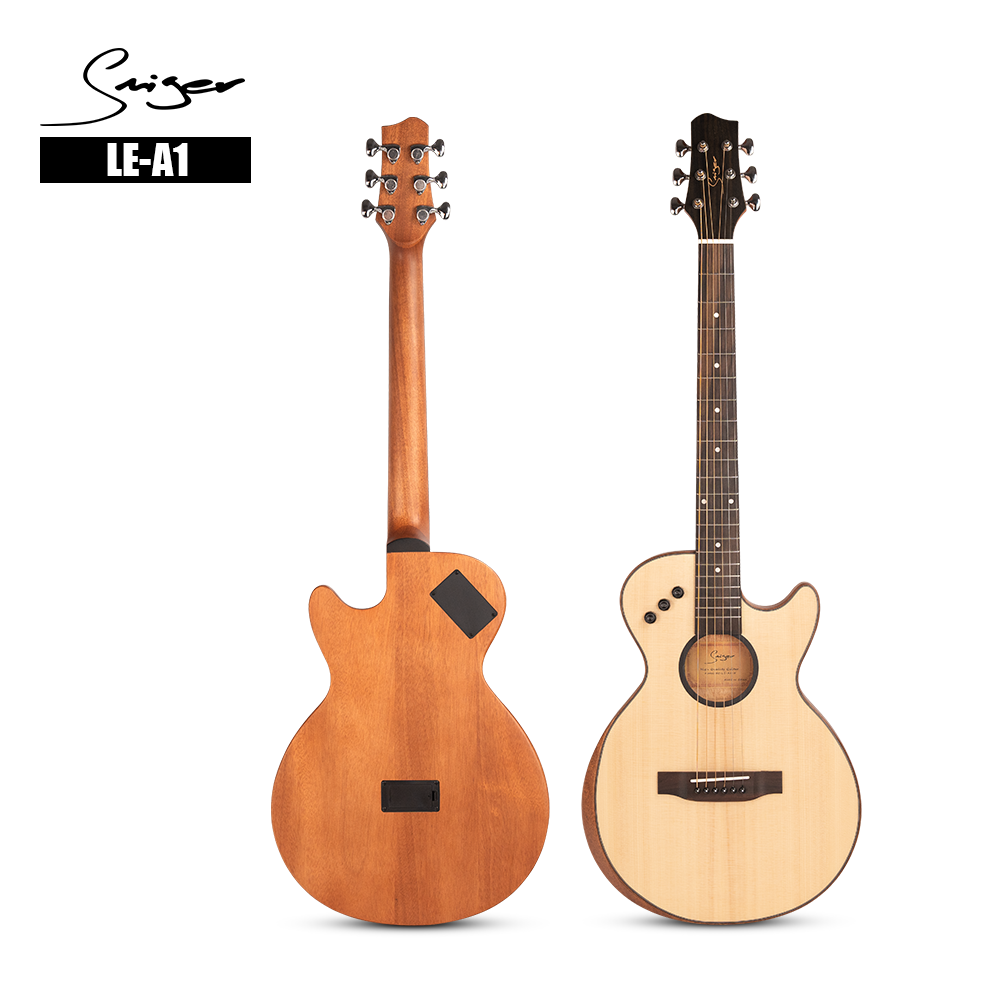
The LE-A1 adds a thin-body format and onboard controls, creating a distinct role beside a conventional full-size acoustic.
Staff should still use the exact product-page wording. “Technical wood” should not be replaced with the name of a natural species, and the presence of a solid top should not be expanded into a claim that the whole body is solid wood. Clear field-by-field language protects both the catalogue and the sales conversation.
Use electric models to open a new category, not to fill a gap
An electric guitar should not be added merely because an assortment feels incomplete. It should introduce a product role that the store is prepared to demonstrate and support. The SMIGER L-G2-i3 is an example of a model with a distinct published feature set: alder body, HSS Alnico V pickup configuration, onboard effects, Bluetooth function and earphone monitoring.
These points change how the model should be presented. A buyer should verify the control layout, confirm how the onboard functions operate, and prepare a short staff demonstration before placing it in a range. Earphone monitoring may be relevant to customers who need a quieter practice option, while the HSS layout gives sales staff a concrete pickup configuration to explain. These are specific reasons for inclusion; they are more useful than a general statement that the model is versatile.
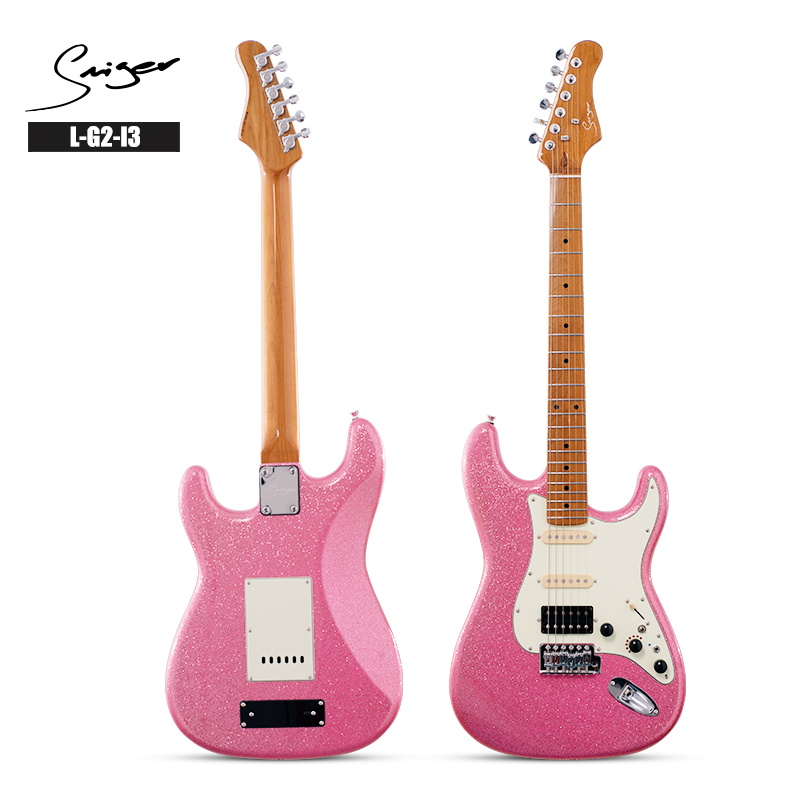
The L-G2-i3 introduces an electric-guitar role with an HSS Alnico V layout and published practice functions.
Electrical functions should be checked on the approved product reference and again during incoming review. The staff description should match the current model instructions rather than assumptions based on a similar-looking instrument.
Build comparisons around observable differences
A clear retail comparison works best when the differences can be seen, handled or demonstrated. For the three examples above, the conversation can follow a simple sequence:
Compare category: acoustic, acoustic with onboard controls, or electric.
Compare body format: 41-inch conventional acoustic, 40-inch thin body, or solid-body electric.
Compare verified materials and construction.
Compare pickup and control functions where present.
Confirm finish, current colours and model identity.
Record any field that requires clarification before catalogue use.
This approach gives each product a stable place in the range. It also makes staff training easier because the team is learning a comparison method, not memorising a different promotional paragraph for every model.
Separate product facts from sales interpretation
A product fact comes from the verified listing or approved specification. A sales interpretation explains why that fact may matter in a particular retail conversation. The two should not be confused.
“40-inch thin-body format” is a fact published for the LE-A1. “May be useful to compare with a deeper full-size acoustic when body reach is part of the customer’s decision” is a cautious interpretation. By contrast, saying that every player will find it more comfortable would turn an individual preference into a universal claim.
The same rule applies to tone, quality and skill level. Wood species, pickup types and hardware provide useful comparison points, but they do not guarantee a particular sound or customer response. Encourage staff to demonstrate the instrument and let the customer compare. For B2B buyers, this disciplined language reduces corrections when product information is reused across websites, feeds and printed material.
Plan range width before colour depth
Range width means the number of genuinely different product roles. Colour depth means the number of finishes offered within one role. Both can be useful, but a retailer should establish the range structure before adding many colours.
If three finishes of one model consume the available display space, another important body format or category may be missing. On the other hand, colour can be a meaningful buying factor when the core model already has a defined role and the retailer has evidence about local demand.
List the current finishes exactly as published, then decide which colours deserve separate stock positions. Do not assume that every colour shown in an old image remains current. Confirm the model and finish combination before adding it to a purchase sheet or online listing.
Prepare a one-page staff comparison sheet
The most useful range document is often a single page. Use one column for each selected model and keep the rows consistent. Suggested rows include body format, top or body material, back and sides where relevant, neck and fingerboard wording, pickup layout, controls, finish, current colours, and the primary range role.
Below the table, give staff three questions to ask the customer. For example:
Are you comparing acoustic and electric instruments, or staying within one category?
Is a conventional full-size acoustic shape important, or would you like to compare a thinner body?
Do you need onboard controls, practice functions or earphone monitoring?
These questions guide the conversation toward verifiable differences. They also help the purchasing team see whether the selected models cover distinct needs or merely repeat one another.
Connect range planning to incoming inspection
The same facts used to select a model should be checked when products arrive. Start with carton and model identification, then compare finish, body format, visible hardware and control layout with the approved reference. Photograph the front, back, headstock and any control area for the receiving record.
For acoustic models, check visible body presentation, bridge area, neck alignment, fret ends and general setup before the product reaches the sales floor. For electric models, add a functional check of pickup switching, controls and any listed onboard feature. This process does not replace a model-specific inspection standard, but it keeps the retail description connected to the item actually received.
If a product differs from the approved wording, pause the catalogue update and clarify the field. Quietly changing the description to fit the delivered item creates an unreliable product record.
Review the assortment with evidence, not assumptions
After the range has been on sale, review each product role using the retailer’s own evidence. Useful questions include whether staff can explain the differences, which comparisons occur most often, which specifications cause confusion, and whether one model repeatedly loses its role to another.
Sales volume alone does not explain the cause. Display position, staff familiarity, local price, available colours and stock timing may all affect the result. Record those conditions before removing or expanding a model. The aim is a range that stays understandable as it changes.
For distributors, collect the same feedback in a consistent format from different accounts. A repeated request for a body format or feature is more actionable when it is tied to model, channel and customer question rather than a broad request for “more guitars.”
Use configuration evidence to separate neighbouring models
| Model evidence | Retail question | Range action |
|---|---|---|
| Pickup layout and switching | Does this model serve a distinct electric-guitar mission? | Keep a clear SSS, HSS or HH role |
| Bridge and setup | Can staff explain function and service needs? | Match stock depth to support capability |
| Body dimensions | Does the acoustic model add a useful fit or use option? | Remove unexplained body-shape overlap |
| Receiving and sell-through | Is the role profitable after preparation and support? | Deepen, test or reduce the model |
Use the HSS, SSS and HH retail range guide and the fixed bridge vs tremolo guide when electric models need clearer roles.
Frequently Asked Questions
How many SMIGER models should a retailer start with?
There is no universal number. Start with the smallest group that covers the business’s main buying situations without unnecessary duplication. Three clearly different roles can be more useful than a larger list of similar specifications.
Can the GN-81D and LE-A1 sit in the same assortment?
Yes, when their roles are explained clearly. The GN-81D is listed as a 41-inch acoustic with a solid spruce top and sapele back and sides. The LE-A1 is a 40-inch thin-body model with a solid spruce top, okoume back and sides, and onboard controls. Their formats create an understandable comparison.
Should a retailer describe solid-top guitars as all-solid instruments?
No. “Solid top” identifies the soundboard construction. Back and side construction must be confirmed separately, and the catalogue should use the exact approved wording.
What should be verified before listing the L-G2-i3?
Confirm the exact model, current finish, HSS Alnico V pickup layout, control arrangement, onboard effects, Bluetooth function and earphone monitoring against the current product information. Staff should also understand the operating steps before demonstrating it.
How often should the product range be reviewed?
Review it whenever specifications or availability change and at a regular business interval using sales questions, staff feedback, incoming records and model-level results. The purpose is to protect clear roles, not to change the range simply because a calendar date arrives.
Measure Every SMIGER Model by Its Commercial Role
After launch, review each model through enquiry volume, quotation conversion, gross profit contribution, stock days, setup time and return reasons. This prevents a wide assortment from hiding duplicated positions or slow-moving colour and specification variants.
Send Vines Music the market, channel, target price steps and the roles that remain uncovered. The objective is a smaller number of clearer decisions, dependable replenishment and stronger unit contribution rather than range width for its own sake.

Related Buyer Guides
A practical next step for distributors and retailers
Choose one model for each product role and build a one-page comparison sheet using only current, verified information. The GN-81D buyer guide, SMIGER acoustic and electric comparison and incoming-condition guide provide the next level of detail. For current SMIGER information, contact Vines Music, email info@vinesmusic.com, or send a WhatsApp message to +86 13826092986.