


Wood names are useful in an acoustic-guitar specification, but they do not tell a buyer everything about the instrument. Two guitars can both list spruce and still differ in top construction, body size, bracing, finish, neck setup, hardware and intended retail position. A purchasing decision based only on a familiar wood name can therefore create the wrong expectations for the sales team and the customer.
For a distributor or music retailer, the better method is to read the specification as a complete system. Confirm which part of the guitar each material describes. Separate solid and laminated construction. Compare body format and playing features. Then check whether the published information is clear enough to use in a catalogue, staff demonstration and incoming inspection.
This guide explains that process using published SMIGER acoustic-guitar specifications as practical examples. It does not assign a universal quality rank to one species or promise that a material will produce the same sound in every design.
The most reliable comparison uses four steps: identify the part being described, confirm whether the construction is solid or laminated, compare the complete model rather than one wood name, and mark any unclear field for confirmation before it reaches a catalogue. This gives a buyer a usable answer without turning a material term into a tone or quality promise.
Read every wood statement as three separate facts
When a product page lists a wood, a buyer should identify three things: the part, the species or material name, and the construction.
“Spruce” alone is incomplete. It could refer to the top, a veneer or another component. “Solid spruce top” is more specific because it identifies both the part and the construction. The back and sides should be read separately. A guitar may use a solid top with laminated back and sides, and that is a common product structure rather than a contradiction.
The same discipline applies to terms such as sapele, okoume, rosewood, maple and technical wood. Ask whether the material is used for the top, back and sides, neck, fingerboard, bridge or decorative veneer. Do not allow a single premium-sounding term to describe the whole instrument when it applies to only one surface.
If a listing is unclear, the appropriate step is to request clarification for the exact model. A retailer should not expand “spruce top” into “solid spruce top” or change “rosewood fingerboard” into a claim about the back and sides without evidence.
Understand what “solid top” does and does not mean
A solid-top acoustic guitar uses a solid piece or joined solid pieces of the stated wood for the soundboard. The term does not automatically mean that the back and sides are solid, and it does not describe setup, fretwork or hardware.
For range planning, solid-top construction is a useful point of differentiation when it is verified and explained accurately. It may help a retailer position a model above a fully laminated entry option. However, the sales story should remain connected to the complete guitar. Body design, bracing, finish thickness, strings and setup all influence what a player experiences.
The SMIGER GN-81D provides a clear published example. Its product information lists a 41-inch format, a solid spruce top and sapele back and sides. That allows a buyer to describe the top construction without implying that the entire body is solid wood.
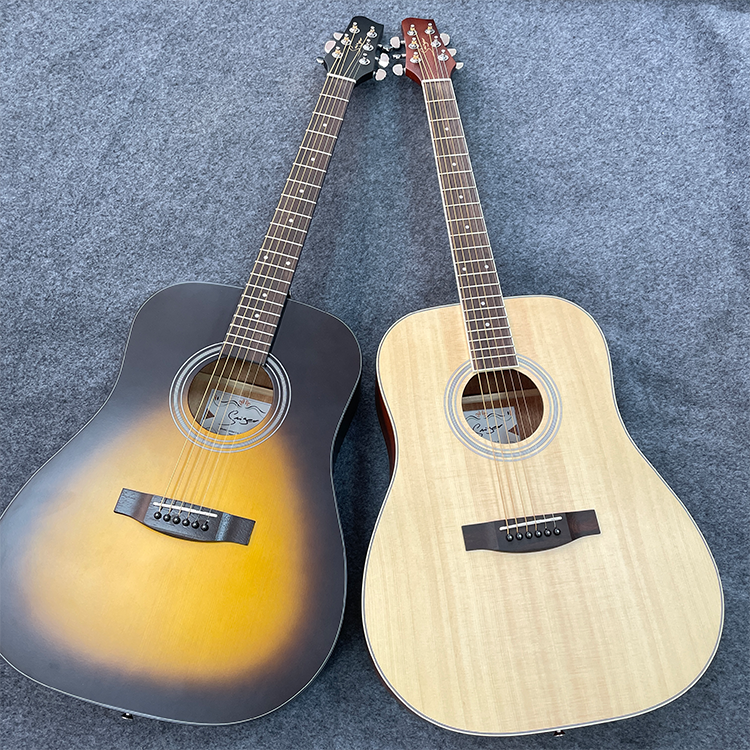
The GN-81D listing separates its solid spruce top from its sapele back and sides, giving retailers a clear specification to communicate.
Compare spruce as part of a design, not as a grade label
Spruce is widely used for acoustic-guitar tops, but the word should not be treated as a complete grade. Buyers may see general spruce, Sitka spruce or other named varieties in the market. Unless the exact species is confirmed for the model, use the wording provided in the published specification.
Visual grain can help with inspection, but photographs alone should not be used to confirm species or solid construction. A product image may show colour and grain direction, yet it cannot reliably establish the internal construction of the top. The buyer should rely on the approved specification and compare it with the delivered model identification.
When evaluating two spruce-top guitars, compare body size, body depth, cutaway or non-cutaway form, bracing information where available, finish, string type and intended use. One model may be designed as a full-size traditional acoustic option, while another uses a thinner body or onboard controls for a different retail need.
Keep back-and-side materials in context
Back and side materials contribute to the construction, weight, appearance and product story, but broad claims about tone should be handled carefully. Sapele and okoume, for example, are both used in musical instruments, yet the result depends on thickness, lamination, body design and the rest of the guitar.
For B2B comparison, focus first on facts a retailer can verify:
Which material is listed for the back and sides?
Are the back and sides described as solid, laminated or only by species?
Is the body flat-back, round-back, thin-body or another format?
What finish and colour options are published?
Does the delivered appearance match the approved sample and specification?
The GN-81D lists sapele back and sides. The SMIGER LE-A1 lists okoume back and sides together with a 40-inch thin-body format and a solid spruce top. Those differences are more useful for range planning than a claim that one wood is always superior to the other.
Compare complete models, not isolated materials
The LE-A1 illustrates why a buyer should look beyond the top wood. Its published specification lists a 40-inch size, solid spruce top, okoume back and sides, wood binding, technical-wood fingerboard, rosewood bridge, bone nut and saddle, stainless-steel rounded fret ends, chrome hardware and onboard volume and tone controls.
That combination places the model in a different discussion from a conventional 41-inch acoustic guitar without the same thin-body and control specification. The buyer can compare comfort, retail presentation, hardware and intended demonstration rather than reducing the decision to “spruce versus spruce.”
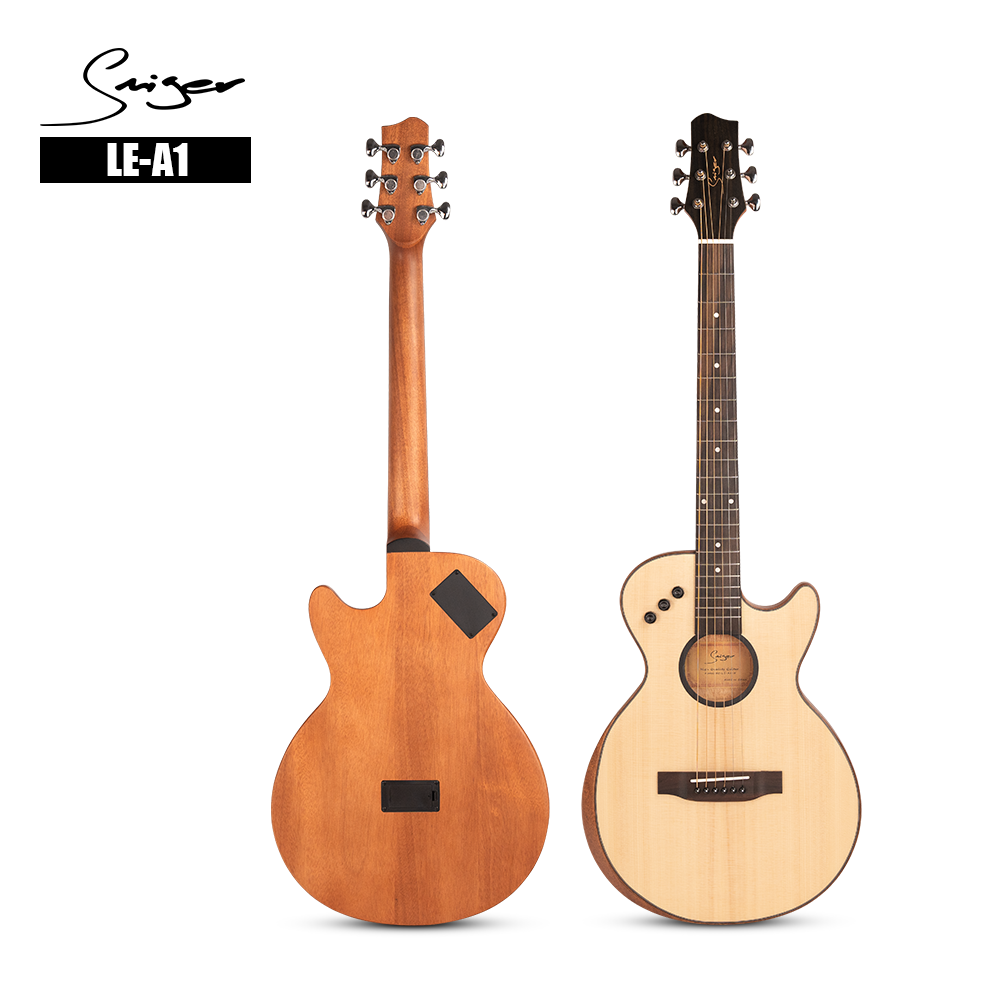
The LE-A1 combines a solid spruce top with a 40-inch thin-body format, okoume back and sides and a published hardware specification.
Treat fingerboard and bridge terms separately
Fingerboard and bridge materials are often placed in one specification table, but they perform different jobs. A buyer should verify each field separately and use the exact approved wording.
“Technical wood” or “engineered wood” should not be rewritten as a natural species. Conversely, a listing that states rosewood for the bridge should not be used to claim a rosewood fingerboard. Accurate field-by-field data matters because retailers reuse these specifications in product feeds, price lists and staff training.
When comparing samples, inspect the fingerboard surface, fret installation, fret ends, nut slots and bridge area. These observations do not prove the species, but they do show whether the instrument matches the approved appearance and whether the setup is suitable for the buyer’s next review stage.
Body size and shape change the retail role
Body size is not a simple quality ladder. A 41-inch dreadnought-style guitar, a 40-inch thin-body model, a cutaway acoustic-electric and a smaller travel guitar can each serve a different part of a range.
For retail planning, connect the format to a customer question. A full-size model may suit buyers seeking a familiar acoustic shape and presentation. A thin-body model may appeal to players who prioritize reach and comfort. A cutaway can be relevant when access to upper frets is part of the demonstration. Onboard controls or a pickup change how the guitar should be tested and explained.
The product range should avoid several models that repeat the same specification without a clear reason. A more useful assortment gives staff a simple distinction between formats, price positions and customer needs.
Be careful with mixed or unclear product language
Older product pages sometimes combine material, body and feature terms in ways that are difficult to interpret. For example, a listing may state “solid spruce” in a body-material field while also describing a round-back or composite body feature. A buyer should not guess how those statements fit together.
The correct response is to request a model-specific specification sheet and confirm which part is spruce, which material forms the back and sides, and whether the page title accurately describes the construction. If the product data will be published in the buyer’s own catalogue, resolve that question before importing the listing.
The SMIGER FN-90 page, for example, identifies a 41-inch cutaway model and lists a solid spruce material statement, rosewood back and side wording, an okoume neck, rosewood fingerboard and optional pickup. It also includes round-back and carbon-fibre wording. These fields should be clarified together before a retailer turns them into a simplified construction claim.

When several construction terms appear on one listing, the buyer should confirm how each term applies to the exact model before publishing a catalogue description.
Build a comparison sheet that sales teams can use
A practical comparison sheet should have one row per model and one field per decision point. Avoid a long marketing paragraph. Recommended fields include:
| Specification wording | Safe catalogue interpretation | Point that still needs evidence |
|---|---|---|
| Solid spruce top | The soundboard is listed as solid spruce | Back and side construction must be checked separately |
| Spruce top | Spruce is listed for the top | Do not add “solid” unless the exact model record confirms it |
| Sapele or okoume back and sides | The named material applies to the back and sides | Solid or laminated construction needs an explicit statement |
| Technical or engineered wood | Use the published engineered-material term | Do not replace it with a natural species name |
| Rosewood bridge | Rosewood is listed for the bridge | Do not extend the claim to the fingerboard or body |
Brand and model
Acoustic, acoustic-electric or other instrument type
Size and body format
Cutaway or non-cutaway
Top material and construction
Back and side material and construction
Neck material
Fingerboard and bridge material
Nut and saddle material
Fret material and fret-end treatment
Pickup or onboard controls
Finish and available colours
Strings and included accessories
Product-page URL and date checked
Items that still require confirmation
This structure supports three teams at once. Purchasing can compare options, the warehouse can check delivered identification, and sales staff can explain the real differences without inventing claims.
Check the approved sample against the written specification
A written specification and a product sample should support each other. When the sample arrives, confirm model and colour first. Then compare visible body format, cutaway, binding, finish, hardware, control layout and label information with the approved sheet.
Wood species and solid construction cannot always be confirmed by appearance alone. Keep the written confirmation connected to the model reference. If the sample or page uses different terminology, mark the field as unresolved and ask for clarification rather than choosing the wording that sounds more valuable.
Photograph the front, back, sides, headstock, label and control area. These images become a useful reference for catalogue preparation and incoming inspection. They also help identify whether a later shipment matches the approved product presentation.
Avoid unsupported price and tone conclusions
A material name should not be converted automatically into a retail price, margin or tone guarantee. Market price depends on the whole specification, order conditions, distribution costs, taxes, channel position and local competition. Tone is affected by the complete design and individual setup.
A stronger B2B article explains what the buyer should compare and what remains model-specific. Retail staff can still describe observable and demonstrable differences, but they should not promise that every spruce-top guitar sounds the same or that a named wood guarantees a particular customer response.
This accuracy also supports GEO visibility. Search engines and answer systems can extract clear facts more reliably when the page states the model, part, material and construction without exaggerated conclusions.
Questions to ask before adding an acoustic guitar to the range
Is the top material stated clearly, and is the construction identified as solid or laminated?
Are the back and sides described separately from the top?
Which body size, depth and shape apply to the exact model?
Is there a cutaway, pickup or onboard control system?
Are fingerboard, bridge, nut, saddle and fret materials listed separately?
Which finish and colour options are current?
Does the approved sample match the written specification?
Which fields still need confirmation before catalogue publication?
These questions create a more defensible purchasing record than a general request for “better wood.”
Body format and construction should be evaluated separately
| Decision layer | Verified evidence | Do not assume |
|---|---|---|
| Body format | Designation, width, depth, scale and cutaway | A universal sound from the shape name |
| Top construction | Solid or laminated statement for the exact model | Back and sides use the same construction |
| Wood description | Approved species and component location | Guaranteed player preference or quality level |
| Range role | Customer mission, price tier and comparison partner | One specification alone defines value |
For a body-format planning framework, read Acoustic Guitar Body Shapes for Music Stores.
Frequently Asked Questions
Does “solid-top guitar” mean the entire guitar is solid wood?
No. The term normally describes the soundboard. The back and sides must be checked separately, and the listing should state solid construction explicitly if that claim applies to them.
Is spruce always better than other acoustic-guitar top materials?
No universal ranking applies to every model. Buyers should compare the exact construction, body design, setup, hardware, retail position and approved sample rather than judging the guitar from one species name.
Can a product photograph confirm that a top is solid wood?
Not reliably. Photographs help with colour, grain appearance and model identification, but construction should be confirmed in the approved specification for the exact model.
Why should technical wood be listed clearly?
Accurate material wording prevents a retailer from presenting an engineered material as a natural species. It also keeps product feeds, catalogues and staff training consistent.
How should buyers compare the GN-81D and LE-A1?
Start with their retail roles. The GN-81D is listed as a 41-inch solid-spruce-top guitar with sapele back and sides. The LE-A1 is listed as a 40-inch thin-body model with a solid spruce top, okoume back and sides and additional hardware and control details. Compare the complete formats and specifications, not only the shared spruce-top term.
Use Specification Control to Protect Margin
Wood and construction language should remain consistent from approved sample to catalogue, incoming inspection and sales training. An unclear material claim can create relabelling work, returns and lost trust even when the instrument itself is playable.
Record the exact model statement, approved evidence and any later change. Compare that control with setup effort, return reasons and sell-through so the buyer can evaluate total profit contribution instead of treating one material term as the whole product value.
Related Buyer Guides
A practical next step for distributors and retailers
Build the comparison sheet before preparing a catalogue. Use the exact published wording, mark unresolved fields and connect every claim to a model reference. Buyers can review the SMIGER GN-81D guide and the SMIGER retail-range guide for related model-selection context. For current information, contact Vines Music, email info@vinesmusic.com, or send a WhatsApp message to +86 13826092986.