


A beginner-friendly ukulele range should make the first buying decision easier without making every instrument look the same. For a distributor or music retailer, that means more than placing several colours beside one another. The assortment needs clear roles: an accessible core model, a visible step-up option and, where local demand supports it, a specialist instrument that expands the category.
This approach helps sales staff explain differences in plain language. It also gives buyers a practical way to review stock depth, product-page information and incoming inspection points. The goal is not to present one ukulele as suitable for every beginner. It is to make each model’s intended place in the range understandable and supportable with verified facts.
A workable opening structure is one clearly documented core ukulele, one step-up model with an observable construction or finish difference, and a specialist baritone or bass only when local enquiries support that role. Retailers can expand colour and stock depth after those positions are understood.
Quick Answer
A beginner-friendly ukulele range should start with a small number of clearly different roles: an accessible core model, a visible step-up choice and a specialist baritone or ukulele bass only when enquiries support it. Verify size, construction, finish and category from the current product record, then decide stock depth from sell-through, preparation time and repeat demand. Clear roles reduce duplicate inventory and help staff explain value without relying on unsupported superlatives or price-only claims.
Begin with the customer groups behind the category
Before selecting models, define who normally asks for a ukulele in your market. A general music shop may serve first-time players, parents, schools, guitarists looking for a smaller instrument and experienced ukulele players. A specialist retailer may see more demand for baritone instruments, solid-top construction or amplified formats.
These groups do not need identical explanations. A first-time buyer may need a straightforward comparison of size, finish and included information. A school buyer may focus on consistency across a group purchase and the ease of identifying models. A guitarist may ask how a baritone format relates to familiar playing habits. A performing player may want an instrument that can connect to a suitable sound system.
Write these customer groups down before choosing the number of models. When every model answers a different customer question, the range is easier to present and less likely to become a collection of near-duplicates.
Give the opening model one simple role
The first model in the range should be easy for staff to identify and compare. Its product record should clearly state the size, top, back and side materials, neck, fingerboard and finish. Avoid relying on broad labels such as “professional sound” or “best quality.” Those phrases do not help a buyer check the instrument or explain why it sits in a particular position.
A useful staff card can be short: model code, size, construction facts, finish and the customer question the model is intended to answer. The same facts should appear on the product page, quotation and carton identification wherever applicable. Consistent naming reduces mistakes when several similar instruments arrive together.
Use the SMIGER ARS-14 as a step-up comparison
The SMIGER ARS-14 provides a clear example of how observable specifications can define a range role. The published product information identifies it as a 24-inch ukulele with a solid spruce top, koa back and sides, mahogany neck, rosewood fingerboard and high-gloss finish. It also has an arm-rest design.
Those details give a retailer several concrete comparison points. Staff can show the difference between a solid-top specification and a plywood construction without describing either one as automatically superior for every customer. They can also point to the gloss finish and arm-rest shape rather than using vague lifestyle language.
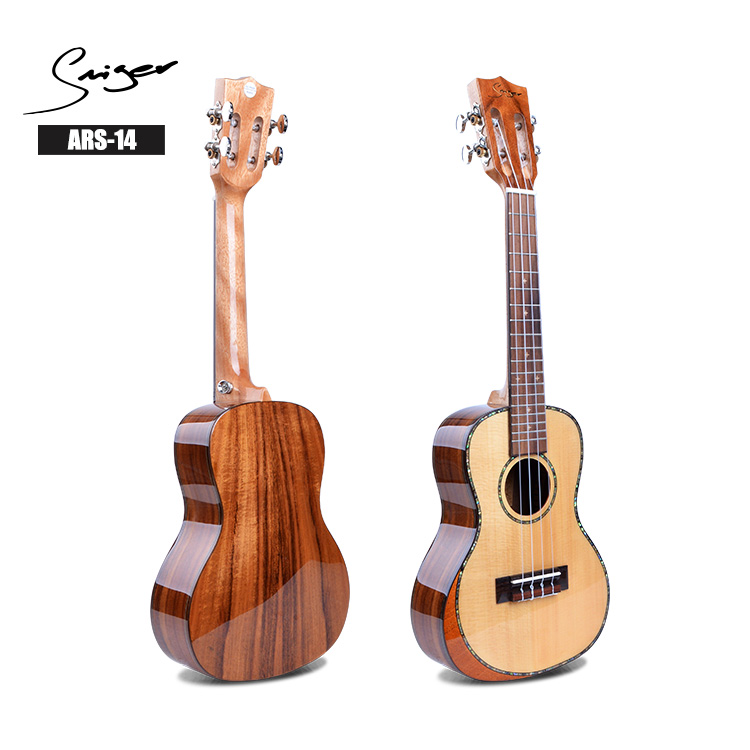
SMIGER ARS-14: a 24-inch solid spruce top ukulele with an arm-rest design.
For range planning, the ARS-14 works best when its role is written before the order is placed. It could be the visible step-up model for customers comparing construction and finish, while a simpler model handles the opening position. That is more useful than stocking several models with no stated difference beyond colour.
Add a baritone option only when the role is clear
The SMIGER GKB-90 is listed as a 30-inch baritone ukulele with koa top, back and sides, a mahogany neck and a matte finish. Its larger format makes it visibly different from a 24-inch model. That distinction gives the sales team a real reason to introduce it instead of treating it as another version of the same instrument.
Baritone demand varies by market, so the initial stock depth should reflect actual enquiries. A retailer that regularly serves guitarists or ensemble players may find the format useful. A small general store may start with display-led testing and reorder only after staff record genuine interest.
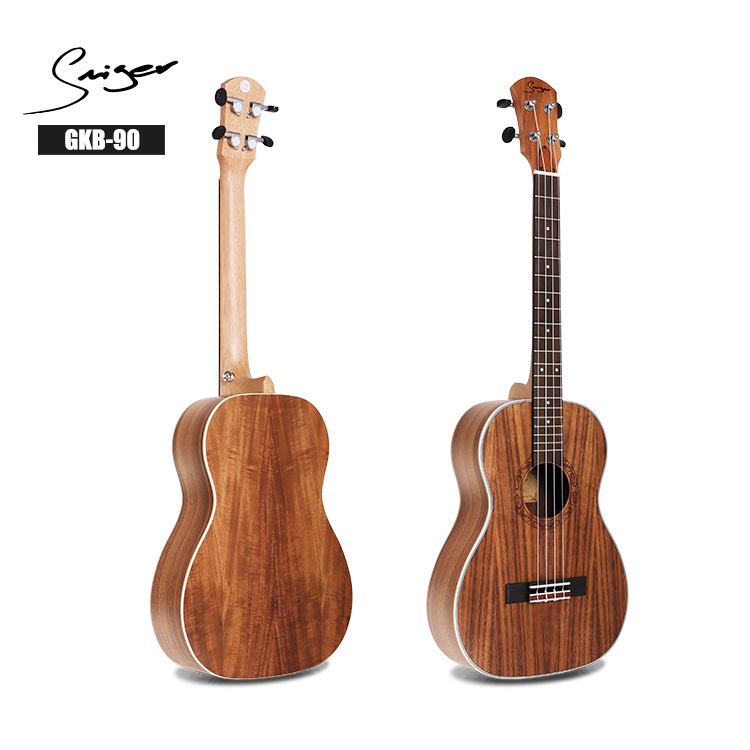
SMIGER GKB-90: a 30-inch baritone ukulele with koa construction and matte finish.
On the shelf and online, label the GKB-90 as a baritone model and state the 30-inch size. Do not assume that every customer understands what “baritone” changes. Staff should be ready to explain the format accurately and confirm tuning and string information from the current product documentation before giving detailed advice.
Treat ukulele bass as a specialist extension
The UBS-03 shows why a range should separate core products from specialist extensions. It is published as a 30-inch electric ukulele bass with AA quilted ash top, back and sides, a mahogany neck, rosewood fingerboard, black die-cast tuners and Aquila strings.
This is not a substitute for the main beginner ukulele position. It opens a different conversation for players or retailers interested in compact bass formats. Placing it in the same comparison row as a standard 24-inch ukulele without explaining the category difference would confuse the assortment.
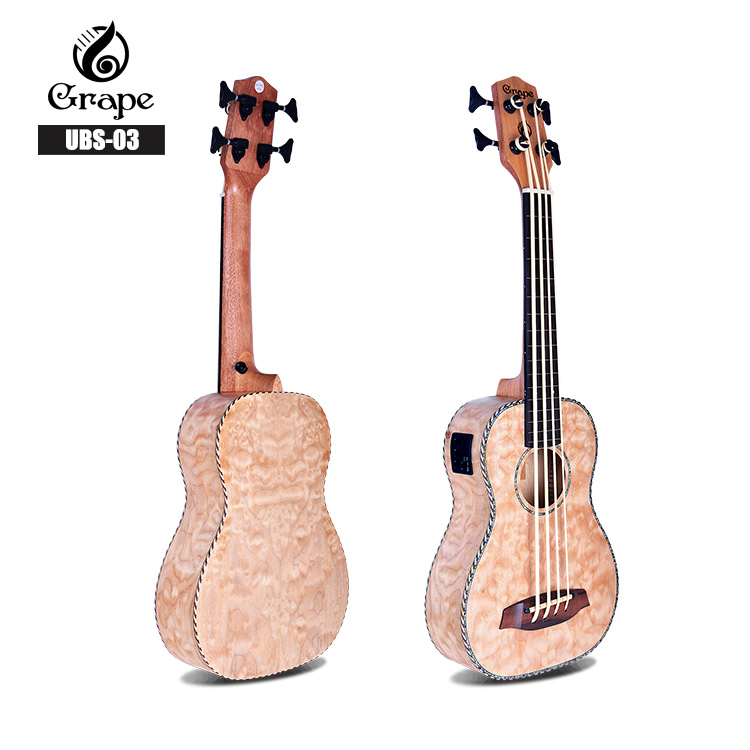
UBS-03: a specialist 30-inch electric ukulele bass with quilted ash body.
For a distributor, the model can be offered as a specialist option rather than included automatically in every opening package. For a retailer, one well-presented display unit may provide better information than deep stock before local demand has been measured.
Compare construction without turning it into a ranking
Material descriptions should help buyers identify products, not create unsupported promises. A solid spruce top, koa plywood construction and quilted ash body are different published specifications. They should not be translated into absolute claims about tone, durability or player level unless there is suitable evidence for the exact instrument.
A practical comparison table can use five fields:
| Field | Why it matters in the range |
|---|---|
| Size and format | Separates standard, baritone and bass roles. |
| Top specification | Gives staff a verifiable construction point. |
| Back and side specification | Helps prevent vague or inconsistent listings. |
| Finish | Provides an immediately visible comparison. |
| Intended range role | Explains why the model is stocked. |
This structure is useful for website filters, sales sheets and incoming checks. It also makes discrepancies easier to spot when a listing, quotation and physical instrument use different wording.
Build the Opening Order by Role, Not by Model Count
Translate the planned assortment into an order that shows why each unit is present. Start by setting a display requirement and a cautious replenishment quantity for each role. The exact quantity depends on local traffic, lead time and account type; it should not be copied from a universal formula. A distributor may hold broader cover stock, while a small retailer may use one verified display instrument and replenish after demand is proven.
| Range role | Evidence before ordering | Opening decision | Review signal |
|---|---|---|---|
| Accessible core | Main beginner enquiries, usable specification record and repeatable receiving check | Prioritise display clarity and reliable availability | Sell-through, ready-to-display rate and beginner questions |
| Step-up comparison | A visible difference in construction, finish or format | Stock enough to compare without duplicating the core role | Comparison-to-purchase rate and margin contribution |
| Baritone | Recorded requests from guitarists, ensembles or experienced players | Begin with measured depth and clear format labelling | Qualified enquiries and reorder interval |
| Ukulele bass | Specialist or performance demand and staff capability | Treat as a separate extension, not an entry substitute | Demonstrations, service questions and confirmed sales |
This role sheet should travel from purchasing to the product page and receiving bench. The buyer defines the reason for stocking the model; content staff publish the verified facts; receiving staff confirm identity and condition; sales staff demonstrate the difference consistently. When those records disagree, resolve the field before the product is promoted.
Retailers planning an opening assortment can send Vines Music the customer groups, desired roles and receiving requirements. That information supports a useful discussion of SMIGER ukulele options and specialist extensions without presenting a fixed package as suitable for every market.
Plan depth after the roles are understood
Range width and stock depth are separate decisions. A retailer may need three clearly different models but only limited opening quantities of the specialist options. A distributor may require more width to serve different account types, while still keeping the main volume around a smaller group of core models.
Track enquiries by model role, not just by category. Record whether customers asked for a standard size, baritone format, solid-top specification, matte finish, gloss finish or an amplified bass option. After a review period, this evidence will show which differences matter in the local market.
Colour can add variety, but it should not replace role clarity. Expanding several colours of a slow model may create more stock-keeping work without answering a new customer need.
Prepare staff to demonstrate differences consistently
A short comparison routine is more reliable than memorised sales claims. Staff can begin by confirming the format and size, then point out construction and finish, and finally explain the model’s place in the assortment. If a technical detail is not confirmed on the current product sheet, it should be checked before it is presented as fact.
The same discipline applies online. Product names, filters, images and specifications should agree. Avoid mixing “solid wood,” “solid top” and “plywood” as if they mean the same thing. For the ARS-14, the published fact is a solid spruce top. For the GKB-90, the listing identifies koa top, back and sides and describes the product as plywood. Clear wording protects buyer confidence.
Connect range planning to incoming inspection
When the shipment arrives, the receiving team should be able to match each instrument to its order and published specifications. Checks may include model identification, visible finish, obvious transport damage, tuners, bridge area, neck condition, string condition and included items listed on the order.
Specialist models need additional attention because they may be less familiar to the receiving team. A baritone ukulele should not be mixed with standard-size stock, and a ukulele bass should be identified as a different product type. Photographs and model codes on the receiving sheet can reduce errors.
Inspection results should feed back into assortment decisions. Repeated confusion about a model name or specification is a sign that the product record needs improvement, even when the physical instruments arrive in acceptable condition.
Run a 30-Day Range Review
Review the new range after a defined selling period instead of expanding it immediately. Record qualified enquiries, demonstrations, sales, replenishment time, markdowns, preparation work and the questions staff could not answer from the approved record. Separate customer interest from completed sales: a baritone that attracts questions but no purchase may need clearer demonstration, different stock depth or a different role.
Calculate contribution after receiving and support work, not only gross margin on the invoice. A model that requires repeated correction can consume technician time and delay display availability. A specialist instrument with slower turnover may still create value when it generates planned appointments, profitable add-on demand or a credible category position. The decision depends on the role agreed before ordering.
At the review, classify each model as expand, maintain, test further or replace. Share recurring specification questions, incoming-condition evidence and verified return reasons with the supply partner. This creates a joint improvement loop: the retailer contributes market and handling evidence; Vines Music can help clarify records, compare SMIGER roles and respond to repeatable supply issues. The objective is stronger unit profit and customer trust, not the largest catalogue.
Frequently Asked Questions
How many ukulele models should a retailer start with?
There is no universal number. A practical opening range often starts with a small set of clearly different roles rather than many similar models. Base the final count on customer groups, available display space and reorder evidence.
Does a beginner-friendly range need only entry models?
No. It needs an understandable starting point, but a step-up model helps customers compare real differences. Specialist formats should be added only when staff can explain their purpose and local demand supports them.
Can the ARS-14 and GKB-90 sit in the same range?
Yes, if they are presented for different roles. The ARS-14 is a 24-inch solid spruce top model with high-gloss finish, while the GKB-90 is a 30-inch baritone model with koa construction and matte finish.
Should the UBS-03 be described as a beginner ukulele?
It is better described by its verified category: a 30-inch electric ukulele bass. Whether it suits a particular beginner depends on the intended use, available guidance and the buyer’s requirements.
What information should be checked before importing product data?
Confirm the model code, size, format, top, back and sides, neck, fingerboard, finish and any electrical or string details shown in the current product record. Remove unsupported performance claims and keep terminology consistent.
Review Ukulele Roles Through Turnover and Repeat Demand
Track enquiries, sell-through, stock days, return reasons and repeat accessory demand for each ukulele role. A beginner model, step-up model, baritone and ukulele bass should not receive equal depth unless demand supports it.
Use the evidence to adjust opening quantities and replenishment. Send Vines Music the customer groups, price steps and specialist requests you are seeing so the range can grow around verified demand rather than catalogue breadth.

Related Buyer Guides
Build the range around decisions buyers can verify
A good ukulele assortment does not depend on exaggerated promises. It gives each model a reason to exist and makes that reason visible in the specifications, images and staff explanation. Start with the customer groups, assign a role to each model, keep specialist products separate and review actual enquiries before expanding depth.
Review the current Ukulele category, then connect the selected models to the packaging and incoming-condition guide. To discuss the range under review, contact Vines Music, email info@vinesmusic.com, or send a WhatsApp message to +86 13826092986.