
English
Views: 0 Author: Vines Music Editorial Team Publish Time: 2026-10-05 Origin: Site


Quick answer: passive bass electronics send the pickup signal through a circuit that normally does not require onboard battery power, while active electronics use a powered onboard circuit to provide functions such as gain or equalization. Some basses combine active and passive modes. Retailers should verify the exact circuit, controls, battery type, bypass behavior and output level on each model instead of treating 鈥渁ctive鈥� as a quality grade or a guaranteed sound.
The commercial difference includes product data, demonstration, battery handling, staff training and after-sale support. A passive model can be the clearer choice for a customer who values simple operation. An active model or dual-mode bass can serve players who need its documented control functions. This guide helps distributors and stores define those roles with facts and repeatable tests.
鈥淧assive鈥� usually describes a circuit that does not use an onboard powered preamplifier. Its controls commonly reduce volume or shape the pickup signal through passive components. 鈥淎ctive鈥� describes a powered circuit, often with one or more equalization or level functions. Exact designs vary, so the label alone does not reveal the frequency points, boost and cut range, battery voltage, switching or output.
A bass can use passive pickups with an active preamp, active pickups, or a switchable active/passive system. Product copy should identify what the manufacturer has approved rather than using 鈥渁ctive pickups鈥� as shorthand for any battery-powered bass. If the source record only says 鈥渁ctive,鈥� request the circuit and control details needed by the channel.

The current JB30-5 record identifies an active/passive selector and a three-position mid-frequency selector; buyers should confirm the current circuit and control map.
Write every control in physical order and record its function. Note the active/passive switch, volume controls, pickup blend or selector, tone or EQ controls, and any frequency switch. Identify the battery type, compartment, installation direction and whether the instrument passes signal when the battery is depleted or removed. Do not assume bypass behavior from the word 鈥減assive.鈥�
The live JB30-5 product record checked for this guide identifies a five-string format, S-S pickups, an active/passive selector and a three-way mid-frequency selector with listed 250, 450 and 700 Hz positions. The G-B10 record identifies an active circuit and 1V+3T controls. These pages provide model examples, while the current approved specification and physical sample should govern a purchase or dealer listing.
Field | Passive circuit question | Active circuit question | Retail evidence |
|---|---|---|---|
Power | Does the instrument require no onboard battery? | Which battery, voltage and compartment are used? | Approved specification and physical check |
Controls | Which volume and tone functions are present? | Which EQ, gain, switch or blend functions are present? | Dated control map |
Bypass | Not applicable unless another powered mode exists | Does passive mode work with a flat or depleted battery? | Repeatable signal test |
Output | What level is observed in the agreed signal chain? | Does switching create a level change? | Meter or controlled listening notes |
Support | Which pots, jack and wiring references are needed? | Which battery and circuit information must be stocked? | Service and consumable record |
Ask what equipment the customer uses, which controls are needed during playing, whether battery management is acceptable and who will support the instrument. A player who shapes sound mainly with an amplifier or pedalboard may value a simpler onboard layout. Another may need verified onboard EQ or the ability to switch modes. The answer depends on the complete system.
Education, rental and fleet buyers may prioritize consistency and handover simplicity. A specialist retailer may support more control options because staff can demonstrate and service them. An online seller needs especially clear control and battery information because the customer cannot test the instrument before delivery.
Do not map electronics directly to genre or skill. Active does not mean professional, modern or powerful in every setup; passive does not mean basic, vintage or weak. Use the customer requirement and the exact circuit.
Use the same bass when it has a documented active/passive switch. Start with a known battery, consistent cable, amplifier or interface input, effects state and volume. Set controls to documented reference positions. Play the same short phrases, then switch modes and state which settings changed.
Avoid judging only by louder output. Level-match as closely as practical when comparing response, because the louder setting can be perceived as better. Record the input setting and any clipping. If the bass uses active EQ, test each control from its identified center or reference point without extreme settings.
When comparing two different basses, acknowledge the other variables: pickups, strings, scale, construction, setup and player attack. The demonstration can show how those complete products behave under the test; it cannot isolate electronics perfectly.
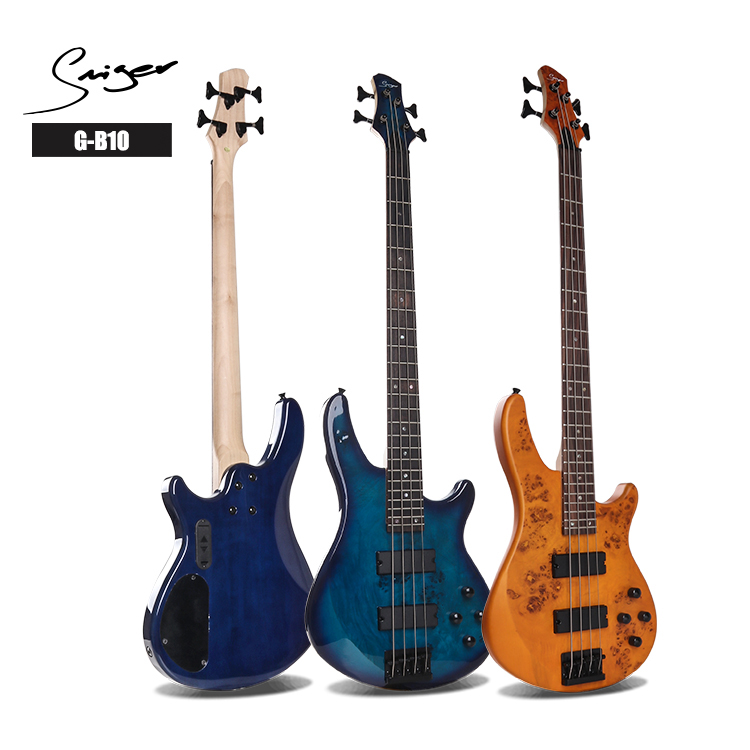
The G-B10 record supplies an active-bass example; current battery, control and service details should be confirmed before range approval.
Inspect the compartment, connector, polarity marking and cover. Confirm the battery type and whether a tool is required. Check for secure contact, visible damage and enough clearance to avoid pinched wires. Use the handling method approved for the model.
Test signal in each documented mode with a known battery. If the specification claims passive bypass, test what happens with the battery removed or depleted under controlled conditions. Record the result rather than relying on a sales description. Also confirm whether leaving a cable connected draws power; this behavior is common in many active instruments but must be verified for the exact circuit.
A handover should include battery information, disconnection guidance and the support route. Do not include broad claims about battery life unless the test method and product version support them.
Test through a known cable and quiet signal path. Operate every control slowly and listen for interruption, scratchiness, unexpected jumps or noise. Compare active and passive modes at safe input settings. An active output may overload an input that was set for another instrument, so lower the gain before connecting or switching when necessary.
Noise can come from the bass, cable, power environment, amplifier, interface or nearby equipment. Isolate one variable at a time. Note the pickup selection, mode, control positions and environment. A statement such as 鈥渘oise heard only in active mode at this setting鈥� is actionable; 鈥渁ctive basses are noisy鈥� is not.
If several units show the same unexpected behavior, preserve model, batch and unit evidence and escalate it. Do not normalize a repeated exception in staff training.
Share your customer groups, pickup and control requirements, preferred string counts, price tiers, quantities and service capability. Vines Music can discuss current SMIGER and LUXARS bass records and confirm which electronics fields require model-level verification.
An active-bass range creates a small but real battery workflow. Decide whether batteries are included, installed for display, removed for storage or supplied at handover. Follow applicable battery and transport requirements for the market and shipment. Store replacements appropriately and record checks for long-held display units.
Give service staff the control map, battery reference, wiring or circuit information available from the supplier, and an escalation path. Sales staff need a shorter card: how to identify the mode, return controls to the reference setting, connect safely and explain battery care.
Include battery handling and diagnosis time in the model鈥檚 commercial review. The feature can still create value, but the operating cost should be visible.
State whether the bass is active, passive or switchable, then name the confirmed controls. If a mid-frequency switch or EQ band is documented, use the approved values and explain the physical control. Identify the battery type and bypass behavior only after confirmation. Use close-up images of the control area and compartment where appropriate.
Link the article to the current bass-guitar category, the four-string versus five-string guide and the dealer-ready product data checklist. Electronics and string count should remain separate filter fields.
Avoid unsupported language about stronger tone, wider genres, professional standards or lower returns. Explain the verified control, the customer task it supports and the test required.
Verify identity, finish, pickups, controls, switch positions, output, battery compartment, current draw behavior if specified, neck, frets, bridge and setup. Record the test equipment and settings. Photograph the control layout and any version marker.
At receiving, confirm that the circuit and control map match the approved sample. Test a defined sample from the shipment and record exceptions. A knob count alone does not prove the internal circuit. If a model version changes, update the approved data and dealer content before release.
Keep active and passive problems distinct from normal setup work. A fret or neck issue belongs in the instrument record; a signal interruption or power issue belongs in the electronics check. Clear classification speeds supplier response.
Review area | Evidence | Buyer question | Possible action |
|---|---|---|---|
Customer fit | Requests for onboard EQ, bypass or simple controls | Does the electronics role solve a stated need? | Keep, reposition or remove overlap |
Demonstration | Mode comparisons and repeated questions | Can staff explain every control? | Improve training or documentation |
Reliability | Battery, jack, switch and circuit service cases | Are issues isolated or repeating? | Correct, escalate or change preparation |
Contribution | Sell-through, margin, setup and support time | What remains after full service cost? | Adjust depth or price review |
Inventory | Age and reorder performance by model role | Is stock proportional to qualified demand? | Maintain, deepen or reduce |
During week one, align product data, sample settings and staff cards. In week two, collect the questions customers ask about active/passive operation. In week three, review batteries, display instruments and service notes. At day 30, compare qualified demand, conversion, preparation time, unresolved cases and stock age.
Choose one documented next step. If customers value a switchable model but struggle with the controls, improve content and training. If a simpler model converts because it fits the mission, protect that role. If the product record is incomplete, request clarification before increasing depth.

Use a clear, version-specific control map so dealers and customers can reproduce active and passive settings.
Passive circuits normally operate without an onboard powered preamp. Active circuits use onboard power for documented functions such as gain or equalization. Exact pickups, controls and switching vary by model.
No. The correct choice depends on required controls, signal chain, battery management, physical product and customer preference. Active and passive are circuit descriptions, not quality grades.
Only if the exact circuit provides a true passive bypass that works in that condition. Verify the model specification and test the physical sample.
Check identity, battery compartment, every control and mode, output level, noise, signal continuity, bypass behavior where specified, setup and the current product record through a known signal path.
State the verified controls and describe observations under a defined test. Avoid universal claims about power, warmth, clarity or genre because pickups, settings, strings, instrument and signal chain all contribute.
Active and passive bass electronics change more than a label. They affect controls, power, signal level, demonstration, inventory support and service. A reliable retailer maps the exact circuit and tests it through a known path.
Give each model a customer mission, publish only confirmed fields and review the full operating cost. This creates a clearer comparison for search users, sales staff and B2B buyers.

Current control and battery information should accompany any active-bass feature description.
Tell Vines Music whether your market needs passive simplicity, active controls or switchable operation, together with string count, price tiers and order plan. We can help structure a current model comparison.