
English
Views: 0 Author: Vines Music Editorial Team Publish Time: 2023-05-11 Origin: Site


Quick answer: retailers, distributors and music programs should review guitar health claims by separating verified product facts, observable program activities and outcomes that require independent evidence. A guitar can be presented as an instrument for learning, practice and group participation. It should not be marketed as a treatment, a way to prevent disease or a guaranteed method for improving mood, memory, confidence, circulation or pain. When a claim goes beyond the product and the activity, pause publication, identify the evidence and obtain the appropriate legal or professional review.
This guide gives marketing teams, category managers and program partners a repeatable way to audit guitar-related copy. It is designed for product pages, dealer listings, school-program descriptions, social content and sales scripts. The method protects trust while keeping the useful part of the story: what the instrument is, how the activity is organized, what support is available and which next step a buyer can verify.
Health and wellbeing language often enters marketing through broad phrases such as “reduces anxiety,” “improves memory,” “prevents pain” or “makes people happier.” These statements may sound familiar, but familiarity is not evidence. They can imply a medical result, a biological mechanism or a guaranteed personal outcome. A product supplier or retailer normally cannot establish those conclusions from a customer comment, an event photograph or a short demonstration.
The commercial risk is larger than a single sentence. Dealers may copy supplier language into marketplaces, teachers may repeat it to families and regional teams may translate it without preserving important limits. One unsupported claim can therefore spread through several channels. A controlled review gives every team the same source, approved wording and escalation route.
Careful language does not make an article less useful. It makes the decision clearer. A business buyer can evaluate the exact guitar, the equipment needed, staff preparation, participation options and service responsibilities. These are concrete elements that can be checked before a program or retail campaign begins.

Describe the activity and the support process that can be observed; do not turn the image into proof of a health outcome.
Start by classifying every important sentence as a product fact, an activity statement or an outcome claim. A product fact describes the exact model or service and needs an approved source. An activity statement describes what people will be offered or asked to do. An outcome claim predicts a change in a person, especially a physical, cognitive, emotional or social change.
| Claim layer | Responsible example | Evidence to retain | Do not publish as a shortcut |
|---|---|---|---|
| Product fact | The recorded model has a compact body and one volume control. | Current model sheet, configuration and revision date | This guitar is comfortable for everyone. |
| Activity | The session includes tuning, a short group part and time for questions. | Program plan, staff owner and schedule | The session eliminates stress. |
| Observation | Three setup delays were logged during the trial session. | Dated operational record and context | Participants were unmotivated. |
| Outcome claim | Participants will improve memory or mood. | Appropriate independent evidence and review | A testimonial or image used as proof. |
This model also helps with AI search and summaries. Search systems can more reliably extract a clearly attributed fact than a paragraph that mixes specification, opinion and a health promise. Keep the subject visible: “the program offers,” “the product record states,” “the participant reported” or “the study found.” Do not remove the source when shortening the sentence.
Prioritize statements about diagnosis, treatment, prevention and biological mechanisms. Examples include lowering blood pressure or cholesterol, preventing heart attack, stroke or arthritis, releasing particular brain chemicals, treating anxiety, correcting posture-related conditions or guaranteeing cognitive improvement. These statements should not remain live while a team searches for support after publication.
Guarantees can also appear without medical words. “Suitable for every age,” “the best gift for anyone,” “will build confidence” and “will create stronger relationships” promise a result that varies by person and context. Replace them with a decision process: check the recipient’s interest, instrument fit, intended activity, complete equipment and local support.
Be equally careful with commercial superlatives. “Best quality,” “most affordable,” “perfect for every style” and “professional for all players” are not made safe by placing them beside a wellbeing article. Use current product facts, the comparison method and the limitations a buyer should understand.
A responsible rewrite preserves the activity while removing the promised outcome. “Guitar reduces anxiety” can become “the session offers a predictable musical task and a choice of group roles.” “Guitar improves social skills” can become “participants can rehearse a shared part using agreed turn-taking and listening rules.” These alternatives describe what the organization controls.
Observable language supports better management. A school can record whether instruments were ready, whether learners understood the next task and whether support questions reached the correct person. A retailer can record which product facts were unclear, which accessories were missing and which setup issues interrupted the demonstration. None of these measures proves a health effect, but each can guide a practical improvement.
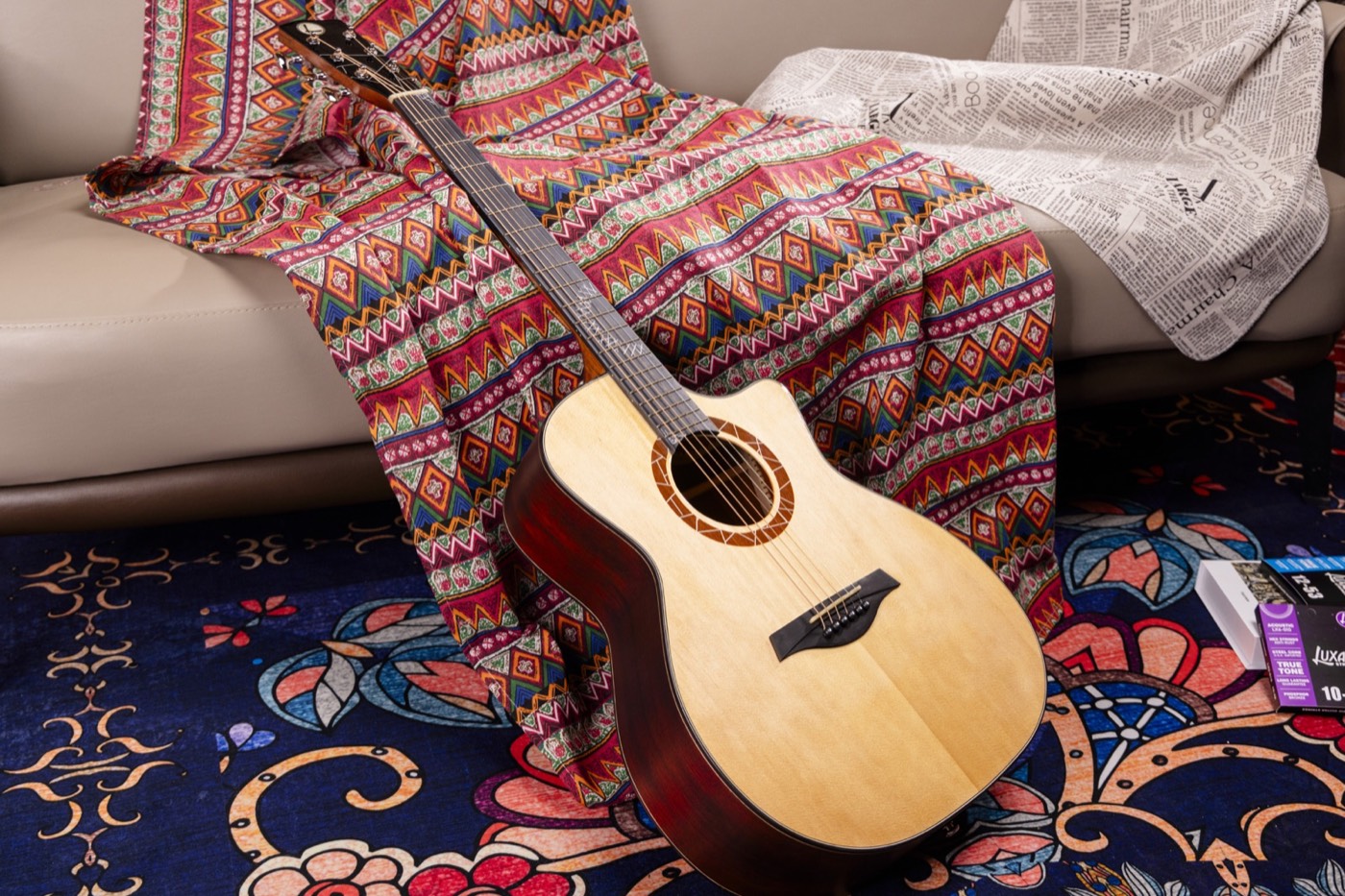
A real use-context image can explain the setting without promising a physical or emotional result.
Every model mention should point to a current approved record. Check the model code, body format, dimensions, control layout, included accessories and any compatibility statement used in the article. If different versions exist, state which version the description covers. Do not carry a material, size or feature from a visually similar product into the chosen model.
Then explain the product’s role without converting the specification into a personal outcome. A smaller format may be an option to compare for a defined space or handling requirement; it is not automatically safer or more comfortable. A control layout may simplify one demonstration; it does not guarantee faster learning. A case may support storage and transport; it does not prove that an airline will accept the packed instrument.
When the required product fact is unresolved, leave it out of the public claim and record the question. A visible blank in an approval table is easier to correct than an unsupported detail that has been copied into dealer systems.
A useful claim register is short enough to maintain. Give every material statement an owner, source, date and approved channel. Record the exact wording rather than a vague note such as “health copy approved.” Translations and shortened social versions should link back to the same entry and should be reviewed when they change the meaning.
| Field | What to record | Review question |
|---|---|---|
| Exact claim | Sentence as it will appear publicly | Does the wording promise an outcome? |
| Claim type | Product fact, activity, observation or outcome | Is it in the correct review route? |
| Source | Model sheet, program plan or external evidence | Does the source support this exact version? |
| Scope | Model, market, program and date covered | Could a dealer apply it too broadly? |
| Owner | Person responsible for approval and updates | Who acts when the source changes? |
| Expiry or review date | Next scheduled check | Is the copy still current? |
Keep screenshots, customer stories and testimonials in a separate evidence category. Verify permission and context before use, and do not present one person’s experience as the expected result for everyone. If a story includes health information, follow the applicable privacy and review process before it enters a supplier or marketing channel.
Send Vines Music the target setting, participant group, product categories and the operational questions your team needs to resolve. We can discuss current SMIGER and LUXARS information for the equipment role while keeping health and educational decisions with the appropriate program professionals.
Front-line teams need short language they can repeat. Begin with the customer or program requirement, identify one verified product fact and explain the next comparison. For example: “You need an instrument for a shared classroom activity. Let us compare the current dimensions, handling and complete equipment for two suitable models, then record any setup or support question.”
If a customer mentions pain, distress or a medical condition, staff should not diagnose the cause or recommend a guitar as treatment. Pause the activity when appropriate, follow the organization’s escalation process and direct the person to qualified help. Product teams can document instrument condition and fit questions without collecting unnecessary medical details.
A script should also explain uncertainty. “We need to confirm that specification for this version” is credible and actionable. It protects the buyer from a copied error and gives the supplier a clear question to answer.
Claims can become stronger as they move between channels. A careful English phrase may be translated into a guarantee, or an AI summary may remove “may,” “in this program” or “according to the participant.” Review the meaning after translation and check the short version separately from the source article.
Provide dealers with approved product facts, image assets, model identifiers and a list of prohibited claim types. When a specification or program changes, update the controlled source and tell partners which text is no longer current. Avoid sending several near-identical files without a visible version and date.
For AI search readability, place the direct answer near the beginning, use descriptive headings and keep table labels explicit. FAQs should answer real buyer questions and should remain visible on the page. Structured data, where the platform supports it, must match the visible questions rather than adding claims that readers cannot see.

Product range decisions should follow verified specifications, access needs and support capacity.
Use operational evidence instead of implied medical results. A retailer can track whether staff found the current product record, whether demonstrations followed the agreed conditions, which questions remained unresolved and whether the next action was completed. A program can track equipment readiness, start delays, participation options, support requests and follow-up ownership.
These measures connect content with commercial quality. Repeated specification questions indicate a product-data problem. Repeated setup interruptions may require a receiving or service change. A high number of unqualified enquiries may mean the article’s CTA or audience is unclear. Each result leads to an action within the team’s role.
Do not use attendance, page views or a positive comment as proof of improved health. State exactly what the number measures and the period covered. Review the data alongside costs, staff workload and service causes before expanding a program or product range.
Use the responsible guitar learning and wellbeing program guide to plan participation, facilitator boundaries, privacy and operational measures. If a player reports physical discomfort, the safer guitar practice guide for schools and retailers explains the role of equipment checks, pacing and qualified escalation without presenting a guitar as treatment.
These pages answer different questions. This article controls public claims; the wellbeing guide addresses program design; the safer-practice guide addresses reported discomfort and operational boundaries. Keep the links specific so readers and search systems can follow the appropriate next step.
Search the draft for words such as treat, prevent, improve, reduce, boost, relieve, cure, safe, comfortable, confidence, memory, mood and relationships. Read the whole sentence because the risk depends on what is promised and to whom.
Separate model facts, program activities, observations and outcomes. Attach the current source and date. If the team cannot trace the sentence, remove it from the publishable version.
Check whether the wording is for a distributor, retailer, school, family or player. A technical note for trained staff may require context that is missing from a short public caption.
Review the SEO title, meta description, summary, image captions, alt text, CTA and social excerpt. These fields should not introduce the claim that the article body carefully removed.
Name the person responsible for the copy and set a review point. Publication is not the end of claim control; copied dealer content and old campaign assets may remain live after the source changes.
Do not present that as a guaranteed retail or product outcome. Describe the activity and observable participation conditions. A clinical or population-level conclusion requires appropriate evidence and review outside an ordinary product listing.
A testimonial can describe one person’s experience when it is factual, permitted and presented with context. It does not prove that every customer will receive the same outcome, and sensitive health information needs appropriate handling.
Pause the activity when appropriate, follow the organization’s process and recommend assessment by a qualified professional. Staff may record equipment condition and fit questions, but should not diagnose or promise that a product change will treat the problem.
Use only current facts relevant to the activity, such as verified dimensions, format, controls, included equipment and support route. Explain the comparison without claiming that the feature creates a medical, emotional or cognitive result.
Send a dated model record, approved images, exact permitted wording, known limits, claim-review contacts and update instructions. Keep commercial terms and availability current, and remove expired or unsupported copy from the source pack.
Responsible guitar marketing begins by stating what can be verified. Name the activity, identify the exact product, show the support route and measure operational results. Remove disease-prevention, treatment, biological-mechanism and guaranteed personal-outcome claims unless they have the evidence and review required for that exact use.
This approach serves SEO and buyer trust at the same time. Clear answers, traceable facts, visible limits and useful next steps are easier for people and search systems to understand. They also give dealers and program partners language that can be reused without silently turning a product description into a health promise.

A playing environment supports product context; it does not establish a universal learning or wellbeing benefit.
Tell Vines Music your market, business type, intended program or retail setting, product categories and unresolved information needs. We can help identify current SMIGER and LUXARS product records and the questions that should be confirmed before dealer publication.